• Shopping Cart Shopping Cart
    0Shopping Cart
FETCH Magazine
  • Link to Facebook
  • Link to X
  • Link to LinkedIn
  • Home
  • Features For Fido
  • FETCH Columns
    • Health & Hounds
    • The Scratching Post
    • Off the Leash
    • Just One Tail
    • Tips 4 Kids
  • K9 Marketplace
    • Advertise With FETCH
  • FETCH Me If You Can
    • Adoptables
    • To The Rescue
  • Contact FETCH
    • Editor’s Paw
    • About FETCH
    • FETCH Issues
  • Click to open the search input field Click to open the search input field Search
  • Menu Menu
Features For Fido

5 Brilliant Artists & Their Muses


By CHERESE COBB

Who can resist a dog’s charms? Not you, not me, not even these five famous artists—whose mutt muses sniffed their way into some of their owners’ most iconic pieces.

Frida Kahlo’s Self-Portrait with Small Monkey

On September 17, 1925, Mexican artist Frida Kahlo, who was already making plans to attend medical school, and her boyfriend Alejandro Gómez Arias were riding in a school bus that collided with a street car. Frida said that a “handrail pierced me the way a sword pierces a bull,” entering through her left hip and exiting through her genitals. Her spinal column and pelvis were each broken in three places. She also broke her collarbone and suffered two broken ribs. Her right leg, the one deformed by polio, was shattered, fractured in 11 places, and her right foot was dislocated and completely crushed.

Although she recovered from her injuries—after three months in a full body cast—she suffered from infertility so she adopted several pets and treated them like her surrogate children. Her favorites were a spider monkey named Fulang Chang and a hairless Xoloitzcuintli (pronounced show-loh-eets-KWEENT-lee) named Mr. Xoloti, both of which she features in this work. Out of her 143 paintings, 55 of them were self-portraits, featuring her treasured furbabies and incorporating her monobrow, faint mustache, dark braids, bright flowers, corset-style shirts, and long skirts.

Charles Schulz and Snoopy

Peanuts creator Charles Schulz’s childhood dog—a black and white pointer named Spike, who would later serve as the inspiration for Snoopy—could understand 50 English words and had a habit of eating pins, tacks, and razor blades whole. He was the subject of “Sparky’s” first published cartoon, which the 15-year-old sent to Ripley’s Believe it or Not.

Snoopy, whose name was suggested by Schulz’s mother, didn’t appear in the first Li’l Folks comic strip, which ran on October 2, 1950. Instead, he trotted through several strips later with a flower that appeared to be growing out of his head. He also walked on all-fours and enjoyed playing ball, chasing sticks, and listening intently to his owner, Charlie Brown. By the mid-1950s, Schulz began to humanize Snoopy—subtly, at first—by introducing thought bubbles. By the early ’60s, he stood up and had more expressive and whimsical features. He was such a phenomenon by the late ’60s that he didn’t need Charlie Brown. “Snoopy doesn’t even know Charlie Brown’s name in most instances,” says Corry Kanzenberg, Curator of the Charles M. Schulz Museum in Santa Rosa, California. “He just calls him ‘the round-headed kid.” Snoopy also became the only character that had a fully illustrated inner life: he had at least 100 different personas, from Joe Cool to the WWI Flying Ace.

Cassius Marcellus Coolidge’s A Friend in Need

In 1903, painter Cassius Marcellus Coolidge started working for the “remembrance advertising” company Brown & Bigelow. He churned out a set of 16 oil paintings, depicting dogs testifying in court, pushing a broken-down car, and wielding a baseball bat. His most famous painting from the series, A Friend in Need, shows seven dogs sitting around a table playing poker until the wee hours of the morning. Often misnamed as Dogs Playing Poker, its title comes from the bulldog handing an ace under the table to his friend.

Reprinted as posters, calendars, and prints by cigar companies, Coolidge’s paintings were considered the epitome of lowbrow culture. While his own obituary described his greatest artistic accomplishment as having “painted many pictures of dogs,” he’s also invented photo stand-ins: old-fashioned carnival attractions where tourists stick their heads on top of cartoon figures.

Pablo Picasso’s Dog

On April 19, 1957, American photographer David Douglas Duncan brought his Dachshund named Lump, who didn’t get along with his Afghan Hound named Kublai Khan, to Pablo Picasso’s villa in the South of France. The Doxie immediately walked up to the Spanish painter and put his paws on him. Picasso looked down and said, “Buenos dias, amigo!” Then Lump leaped into his arms and gave him a kiss. A mutual love affair began. “He more or less said, ‘I’m staying here.’ And he did, for the next six years,” Duncan recalled in an interview on a visit to Paris.

Picasso described Lump—which means “rascal” in German—as indescribable: “Lump, he’s not a dog, he’s not a little man, he’s somebody else.” He also honored him by including him in several sketches and more than 40 paintings, which were based on Diego Velázquez’s Las Meninas. Lump, who was suffering from a spinal problem common to his breed, passed away ten days before Picasso, on March 29, 1973.

Edvard Munch’s Dog’s Face

Edvard Munch is famous today as the creator of a single image, The Scream. His painting of a sexless, twisted, fetal-faced creature with mouth and eyes open wide in a shriek of horror captured the illness, madness and death that accompanied him throughout his life. His mother died of tuberculosis when he was 5, an older sister 10 years later, another sister went mad, his father and a brother died before he was 30, and the artist himself had a severe nervous breakdown when he was 45. He also struggled with alcoholism and bipolar disorder with psychosis, which lead up to him shooting two joints off his left hand’s ring finger.

In his later years, Munch, who never married, withdrew from society, living alone without servants or housekeepers. Only his dog Fips, who had “an old sage’s soul living inside of him,” kept him company while he devoted his time to his paintings, which he sometimes referred to as his children. Munch even took his dog to Roede’s cinema, where they watched Charlie Chaplin’s films together. If Fips no longer enjoyed the film, he would start barking and they would immediately leave the show.
June 15, 2018/by Cherese Cobb
https://fetchmag.com/wp-content/uploads/2021/10/Fetchlogo2022rgb-3-300x175.jpg 0 0 Cherese Cobb https://fetchmag.com/wp-content/uploads/2021/10/Fetchlogo2022rgb-3-300x175.jpg Cherese Cobb2018-06-15 11:40:432023-12-29 12:48:525 Brilliant Artists & Their Muses
Off-The-Leash

Q & A with Britney Kruesel

Who is the woman behind Lost & Hound?

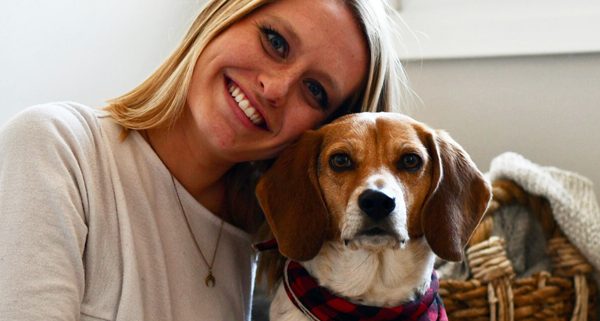
Britney Kruesel is the girl behind Lost & Hound! I have two dogs, Bella, a 3lb Chihuahua and Milo, an always hungry Beagle. Aside from helping other rescue dogs, my dogs were truly the inspiration behind the brand. I work full time for the Wisconsin Humane Society as the youth programs specialist, coordinating programs designed to increase empathy toward animals and impact children and their community in a positive way. After a full days work at the shelter, I come home, take my dogs for a walk, make dinner and then spend another 4-6 hours cultivating new ideas for Lost & Hound, fulfilling orders and making updates to my website, www.lostandhoundmke.com. I usually fall asleep with my laptop on my lap!

How much time do you devote to volunteering?

Before I began working full time at an animal rescue, I volunteered as part of an internship at the Coulee Region Humane Society in Onalaska, socializing dogs and assisting with the pet therapy and youth programs. I have fostered a handful of dogs as well as helped assist families in finding their perfect match. In 2016, Milo and I became a registered pet therapy team through Health Heelers/Pet Partners as a way for us to strengthen our bond, but also as a way for him to share his sweet old soul with those who may benefit from the therapeutic companionship of a dog. Milo and I are lucky enough to spend a couple evenings a month volunteering at memory loss facilities and other youth programs around the city.

How many dogs have received toys to help them transition?

Just under 1,000 and counting (thanks to our loyal customers!).

What’s new?

I’m always looking for new patterns for our bandanas and bow ties. I am also looking into the possibility of a new style leash, collar, additional toys, as well as fun new human goods for those who don’t have a pet but would like to support Lost & Hound’s mission.

We have a few events lined up. Barktoberfest, Fromm Fest and Brady Street Pet Parade to mention a few. We hope to see you there!

If you had to sum up your photography/art in one word … what would it be?

Mindful

Anything else you would like to share?

Our Lost & Hound bandanas can also currently be found in three Milwaukee stores, LOCALmke, MilwaukeeHome and URSA, with additional partnerships brewing as we speak.

Follow along for more updates and announcements on Instagram or Facebook: @lostandhoundmke!

June 15, 2018/by Nastassia Putz
https://fetchmag.com/wp-content/uploads/2018/06/lost.jpg 468 600 Nastassia Putz https://fetchmag.com/wp-content/uploads/2021/10/Fetchlogo2022rgb-3-300x175.jpg Nastassia Putz2018-06-15 10:36:532018-06-15 10:38:04Q & A with Britney Kruesel
The Vet Is In

Bloat: What You Need to Know

By KERRI WIEDMEYER, DVM, WVRC

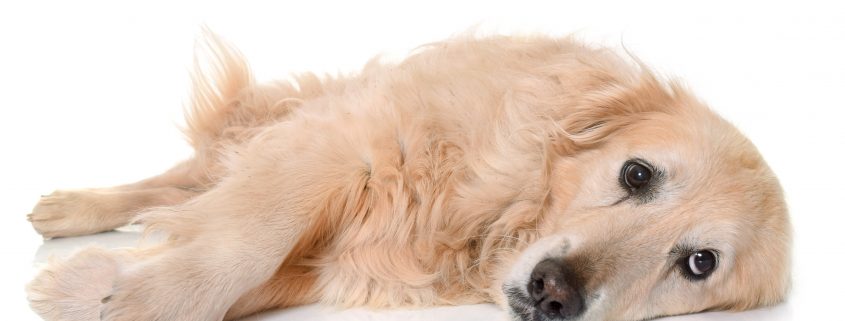
Bloated may be how we all feel after a nice holiday meal, but Bloat in a dog is a very different kind of bloat. Bloat, otherwise known as gastric dilatation and volvulus (GDV), is a very serious condition that occurs when the stomach fills with gas and then rotates, causing further distension and a series of severe complications.

How Do Dogs Get Bloat?

That is the million-dollar question. No one knows the exact cause of bloat; however large breed, deep-chested dogs are more likely to bloat than other breeds. Older dogs are also more commonly seen with bloat than younger dogs. In some cases, eating or drinking large amounts and then being active is thought to cause bloat. There is also thought that eating out of elevated food dishes may increase chances of bloat as dogs may swallow more air when eating.

Unfortunately, there are many times when dogs present with bloat with no predisposing cause; and, although it is much less common, small breed dogs can bloat.

What Does Bloat Look Like?

Dogs with bloat can be restless and unable to get comfortable or lay down. They will hypersalivate/drool and try to vomit, but nothing will come out. They can have very distended abdomens that can be very painful. They may also have very fast heart rates and changes in breathing. In severe cases, they may collapse or be unable to stand. It is very important that if you see any of these signs that you have your dog evaluated by a veterinarian immediately. As veterinarians, we understand that each dog can show different variations of these signs; if there is any concern, an owner can always call a veterinary clinic and ask their opinion.

Why is Bloat an Emergency?

Bloat sets off a cascade of damaging events to the body. As the stomach fills with air, it expands and starts to cut off blood returning to the heart. The expansion of the stomach then puts pressure on the diaphragm, making it difficult for the dog to breath. The stomach then starts to rotate, cutting off the blood supply to the stomach. When the stomach rotates, it can entrap the spleen and thus cause damage or cut off blood supply to the spleen and even rupture blood vessels. All of these changes lead to the dog going into shock. Blood pressure drops, arrhythmias and internal bleeding can occur as well as sepsis. Unfortunately, death can occur in a matter of hours if bloat goes undetected and untreated.

All of these changes happen very quickly, which is why it is so important for an owner to recognize the signs of bloat and get them to a veterinarian as soon as possible.

How do you Treat Bloat?

Unfortunately, there is nothing that an owner can do at home. It is imperative that the dog gets to a veterinarian as soon as possible. Typically, a radiograph will be performed to diagnose a GDV. These dogs then require pain medication, intravenous fluids and emergency surgery immediately. The surgery consists of de-rotating the stomach back to its normal position and then tacking it to the body wall. This is called a gastropexy. If the spleen was involved in the twisting, then it may have to be removed as well. Even after the surgery is performed, these dogs are not out of the woods. There are many complications that can still arise after surgery and it is very common for these dogs to be in the hospital for multiple days. As many as 15 to 30 percent of dogs will not survive bloat even with immediate care and surgery.

Preventing Bloat

Today many people are putting their minds at ease early on by getting prophylactic treatment done. If you own a large breed dog that is more likely to bloat, a gastropexy can be performed when the dog is spayed or neutered.

This procedure will not prevent the stomach from distending with gas, but it will prevent the stomach from twisting/ rotating. The “twisting” is what makes a GDV a surgical emergency. Preventing this by tacking the stomach at an early age will likely save an owner from some sleepless nights and an expensive emergency surgery.

Other considerations to try and prevent bloat are feeding several small meals a day, discouraging drinking large amounts of water at one time, allowing some time between eating and activity, and feeding on the floor.

Hopefully knowing some of these preventative tips will decrease the chances of your furry family member bloating; however, if you see the signs listed above do not wait! Get that loved one to a veterinarian.

June 15, 2018/by Kerri Wiedmeyer
https://fetchmag.com/wp-content/uploads/2018/06/golden.jpg 3230 5000 Kerri Wiedmeyer https://fetchmag.com/wp-content/uploads/2021/10/Fetchlogo2022rgb-3-300x175.jpg Kerri Wiedmeyer2018-06-15 09:56:322020-07-22 21:31:37Bloat: What You Need to Know
The Vet Is In

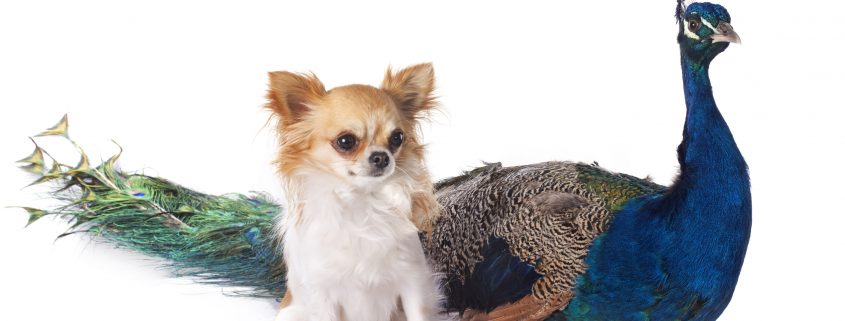
Have You Heard the One About the Peacock?

By MEGAN TREMELLING, DVM, LVS

In January, someone tried to take a peacock on a United Airlines flight, claiming it was an emotional support animal (ESA). Last June, a 50-pound dog that was traveling on Delta as an ESA badly mauled the face of another passenger. So much for the friendly skies.

Don’t get me wrong here. I’m not opposed to the idea of ESAs. Animals can be an incredible balm to the human psyche even when it is in perfect working order. Mental health is extremely complex, and if somebody needs their dog with them to be able to manage, I’m not going to criticize. Fortunately, the TSA views ESAs as aids that allow people to live their lives, going a step beyond the job of “pet,” and so ESAs are allowed in airports and airplanes. Traveling with a disability can be challenging enough without the airlines placing undue burdens on the people who need these animals to get by.

On the other hand, when an airplane cabin starts to resemble a petting zoo, and passengers are being taken away by ambulance, clearly there is a flaw with the system. A big part of the problem, of course, is the irritating phenomenon of people pretending their dogs are ESAs, or even service animals, when they really aren’t.

Why would someone pretend to have an ESA or service dog, instead of admitting that their dog is a pet? For one thing, traveling with a pet can be challenging. People are understandably wary of putting their pets in cargo, given some tragedies that have occurred there. Whether in cargo or in the cabin, there are fees to be paid, and the airline may turn your pet away if there are already too many animals on the flight. ESAs and service dogs, however, sometimes travel for free, and are more likely to be accommodated in the cabin regardless of the number of animals on the airplane or the size and weight of the dog.

This does not change the fact that pretending your pet is an ESA is clearly unethical in all cases, and is criminal in some areas. There is quite simply a limit to the number of animals that can fit on a given airplane before things get disruptive. Like disabled parking permits, those spaces should be reserved for people who actually need them.

In an attempt to reduce abuse of the system, some airlines have begun to use more stringent restrictions on ESAs. Delta, for example, has quite an extensive list of animal species that are not permitted on board. United now requires customers with ESAs to bring “a veterinary health form documenting the health and vaccination records for the animal as well as confirming that the animal has been trained to behave properly in a public setting.”

Owners are notoriously bad at assessing their own animals’ behavior, so I can see why the airlines want to get a third party to vouch for the dog, but many veterinarians are wary of going on record stating that their patients have been trained to behave properly. For one thing, even a dog that is well-mannered under ordinary circumstances may find the conditions on an airplane to be a little much. Let’s face it, after standing in line at security, navigating the hubbub of the airport, and then getting squeezed for hours into a cramped space that makes deafening noises and ear-popping pressure changes, even the humans are just about ready to bite somebody. There is no way that I or any other veterinarian can tell whether a dog that behaves nicely in the clinic will continue to do so in flight.

People who genuinely need ESAs will be the ones to suffer if they can’t produce the paperwork the airlines now expect. Even service dogs from an accredited training program, which are expertly-trained to tolerate quite challenging conditions without causing trouble, may find it hard to get on board.

It remains to be seen how to best balance the needs of people with disabilities who rely on their animals to function and the other passengers’ basic expectation of reasonable safety. Veterinarians, representatives of the air travel industry, and disability advocates are attempting to work together to find a way to ensure that genuine service dogs and ESAs are accommodated without putting other passengers at risk. But one thing is clear: pretending your pet is a service animal is not okay.

June 15, 2018/by Megan Tremelling
https://fetchmag.com/wp-content/uploads/2018/06/peacock.jpg 3371 5000 Megan Tremelling https://fetchmag.com/wp-content/uploads/2021/10/Fetchlogo2022rgb-3-300x175.jpg Megan Tremelling2018-06-15 09:49:482020-07-22 21:31:51Have You Heard the One About the Peacock?
Features For Fido

5 Top Breeds Used in Art

By CHERESE COBB

Thirty-five thousand years ago represents a special time in human history: the creation of cave art. Among handprints and humanoids, there was man’s best friend. After the invention of portable art in the Old Stone Age, these five dog breeds made appearances lounging on the laps of kings and queens, nuzzling the faces of famous creatives, and comforting the children of commoners—and that’s just a small fraction of the dog art that exists between the past and the present.

Pugs
Bred to sit on the laps of Chinese emperors during the early Shang Dynasty, Pugs were considered symbols of status and protection. Nicknamed “Foo Dogs” by Silk Road travelers, they were believed to be able to take down lions, which aren’t even native to China. This myth is most likely grounded in traditional Chinese statuary. Foo Dogs resemble Pugs but are actually stone lions that are covered in armor with their mouths open in mid-roar. They’re commonly placed at businesses, temple gates, home entrances and estates. Designed in pairs, the female (yin) protected the people dwelling inside the home while the male (yang) protected the structure itself.

During the 1400s, merchants and travelers brought Pugs—who once had longer muzzles, legs, and tails—to the Netherlands, where they spread across Europe, becoming a French favorite. “The women of Louis XVI’s court could afford to have these little, live-in warmers,” says Shannon Monroe, an art historian at Suffolk County Community College in Selden, New York. “It’s no well-kept secret that Pugs aren’t the slimmest of dogs. They were able to keep their masters warm by sitting on their laps, laying on their feet, and getting in bed with them.”

By the 1700s, Pugs had “exploded onto the Western art scene”. William Hogarth incorporated the little dogs, including his own named Trump, into many of his paintings. Johann Joachin Kaendler, a sculptor in the late 18th century, even created an entire series of Pug figurines, which served as a secret emblem for the German underground Freemason Lodge known as the Order of the Pug.

Greyhounds
Greyhounds originated in Egypt around 9000 B.C. and are the only dogs mentioned by name in the Bible. Frequently displayed on murals in the tombs of the Pharaohs, Queen Hatshepsut—the second female pharaoh—traded four of her finest Greyhounds for cattle herds, myrrh trees, a living southern panther, and ten-foot-high piles of gold, spices and fur.

Greyhounds graced the backs of ancient Greek coins, and Hippocrates, the Father of Medicine, often painted them lying near his feet. “In Homer’s epic, the Odyssey, Argo is the beloved and loyal dog of King Odysseus, and although the faithful and tragic animal’s breed is never officially given by the poet, he’s mentioned to have been a swift lean hunting dog, which has lead many scholars to believe that he was a Greyhound,” says Monroe.

Nearly becoming extinct during times of famine in the Middle Ages, the breed also makes many appearances in medieval manuscripts, sometimes in the company of mythological creatures such as griffins and dragons. A symbol of celebrity and loyalty, the breed was a favorite of Queen Elizabeth I, the last Tudor monarch, and Queen Victoria’s husband Prince Albert. “The dog in [19th century painter] Paul Gauguin’s Pastorales Tahitiennes was probably a Greyhound since the scene he sets is one where a beautiful island woman plays the flute, an instrument devoted to the adoration of an island moon goddess,” Monroe says. “Being European—and liking to inject a bit of that iconography into his work—he’d have been familiar with Western depictions of Diana, goddess of the hunt and moon, and her Greyhounds.”

Collies
Collies were brought to England in the 1800s and were shown under the name “Scotch Sheep Dog” in the Birmingham English Dog Show. Queen Victoria had at least two Collies, Noble and Sharp, who were very ill-tempered to everyone but the Queen, according to the Pall Mall Gazette. Reigning for 64 years, she most likely helped the popularity of the Collie and its transition from working dog to family pet.
Charles Burton Barber, a popular English painter of children and pets, captured the special relationship between this breed and children. “A Special Pleader shows a perfectly charming scene of a little girl being punished and the dog looking beseechingly at someone out of the composition, presumably the child’s caretaker,” Monroe says. “The dog’s expression not only gives the painting its name but alludes to the Collie’s charm as being a caring, special member of English households.”

Collies were also popular with the Pre-Raphaelite Brotherhood, a group of English painters, poets, and critics founded in the late 19th century. “In William Hunt’s Collie and Lamb, the dog stands over the obviously distressed lamb [a symbol of innocence and allegory of sacrifice] caught in the snow and calls for help,” Monroe says. Richard Ansdell, an English oil painter of animals and genre scenes, also painted the breed working in nature, “almost evocative of British Romantic era paintings with a touch of the sublime in a stormy sky and a nostalgia for the pre-industrial revolution era.

Papillons
One of the oldest of the toy spaniels, the Papillon (pah-pee-yown), also called the Continental Toy Spaniel, has a high-domed head and flashy-looking fringed ears that somewhat resemble butterflies. The “big dog in a small body” also comes in a drop-eared variety called the Phalène (fa-len), which means “moth,” a cousin of the butterfly that folds its wings at rest.

Found in Europe as early as the 1200s, the breed’s ancestry is a mystery. While Italy, Belgium, France, and Spain are all strong contenders, a terracotta statue of the breed was discovered in a second-century Roman tomb in Belgium. During the 17th century, Italian breeders transported the little dogs to the court of Louis XV on the backs of mules. Madame de Pompadour, King Henry II of France, and Marie Antoinette—whose dog named Thisbe stood faithfully outside the prison where the hapless queen awaited beheading—owned Papillons. The breed has been traced back to depictions from the 16th century: a testament to its tenacity and staying power. Old masters like Rubens, Fragonard, Van Dyke, and Watteau portrayed Papillons in various artworks, usually accompanying their doting mistresses. “Titian painted them into so many of his works that they became known as Titian Spaniels,” Monroe says. In his Venus of Urbino, a young woman reclines on a bed in an opulent Renaissance palace. She is sensuous and gazes at the viewer kindly. A Papillion, a symbol of marital fidelity, sleeps at her feet while a maid looks down upon a young child playing, which symbolizes motherhood. “The little Papillion has survived…better than the royal families in whose courts they were once such a favorite,” says June Peterson-Crane, a historian at the Papillon Club for America. “Men, women, and children of all ages take them into their laps and hearts.”

Xoloitzcuintlis
Perhaps, the Xoloitzcuintlis’ (pronounced show-loh-eets-KWEENT-lee) ego stems from the fact that it’s one of the most easily recognized and most often depicted dog in the Americas. “Beginning as early as 300 B.C., they appear as single effigy vases, as dancing figures, as old and wrinkly and pregnant, and sometimes with an ear of corn in their mouths,” Monroe says. The Olmec tribe, often regarded as the mother culture of Mexico, and the Aztecs raised Xolos (“sho-los”), which were eaten by the wealthy, usually only on special occasions. They conducted canine sacrifices by shooting them with arrows, asphyxiating them, or throwing the hog-tied animals on rocks before extracting their hearts, which were later cooked and given to Tlaloc, the rain god. The Mayans also mummified “Colima dogs,” believing that they would eventually join them in the underworld, called Xibalba, roughly translated as “place of fear.”

During WWI, military scientists experimented on the Mexican Hairless with poisonous gases because of the similarities between the animals’ slightly waxy skin and that of humans, which accelerated the already-dwindling population. It wasn’t until the mid-20th century that the breed caught the eye of artists. Mexican muralist Diego Rivera painted a series of frescoes on the stairway walls and corridors of the Palacio Nacional: one depicts a Xolo snarling at a European dog imported by the Spanish conquistadors. They also make cameo appearances in several of Frida Kahlo’s self-portraits including Itzcuintli Dog with Me and Portrait with Small Monkey.

June 15, 2018/by Cherese Cobb
https://fetchmag.com/wp-content/uploads/2021/10/Fetchlogo2022rgb-3-300x175.jpg 0 0 Cherese Cobb https://fetchmag.com/wp-content/uploads/2021/10/Fetchlogo2022rgb-3-300x175.jpg Cherese Cobb2018-06-15 09:36:472023-12-29 12:49:115 Top Breeds Used in Art
Features For Fido

Talented Shiba Inu Creates Amazing Paintings

By CHERESE COBB

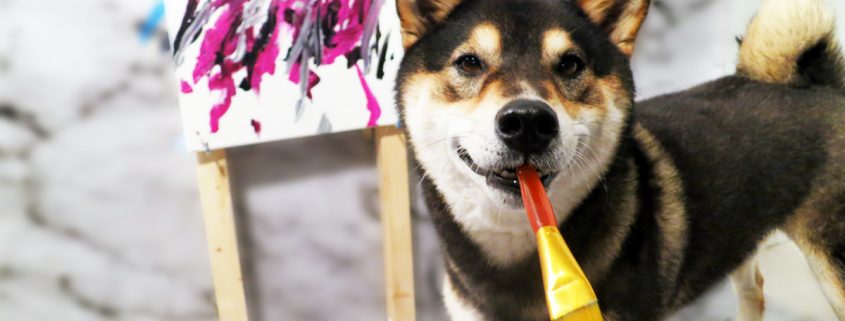
Just call him Pablo Pawcasso. Hunter, a 5-year-old black-and-tan Shiba Inu from Alberta, Canada, has learned how to paint abstract masterpieces by crosshatching non-toxic acrylics in a drippy, streaky and swirly style.

His owners, Kenny Au, a computer engineer, and Denise Lo, an ESL teacher, discovered his hidden artistic talent when they were looking for a new hobby to teach him after he “got as far as he could go” in regards to agility courses. Incredibly crafty and intelligent, proud and independent, careful and tidy, Hunter enjoys exploring new hiking routes, chasing backyard birds and solving children’s puzzles.

“He needs…physical and mental challenges to be happy,” Lo says. “He’s either sleeping soundly or 100 percent ready to accomplish his goals.

A year ago, they got him a little piano, but he hated it. Then a blank space on their wall inspired them to teach Hunter a doggone good trick: how to create art by painting paper with short, confident strokes.

“We had a large blank wall that needed something to go on it, and we thought about how we could make something that the whole family could contribute to,” she says. “Because Hunter is such a calm, careful and responsive dog, we figured he’d be able to learn the brushing motions to create some kind of memento for us. We were really surprised at how good the result was right off the bat.” So, they shared his work on Facebook and Reddit where it generated a lot of memes and even a Photoshop battle.

“We don’t paint every day,” Lo tells FETCH. “Hunter usually barks and stares at us when he wants to do it.” Then he patiently stands in front of a blank piece of acrylic paper, taped on top of a black tarp by his humans. He’s extremely picky about the weight of the brushes and how chewy they are. When he finally chooses one, his owners dab it in the paint and stick it between his teeth. After making a brush stroke on the paper, he’s handed another brush with a different paint color and rewarded with kibble.

“It’s not much, but it’s different from the brand that we usually feed him. He thinks it’s a treat,” she says. “When he learns a new trick, however, he’s…visibly proud of himself, so it isn’t just the treats that motivate him. We can definitely see that he enjoys being placed in different environments and learning new things, especially after struggling with it. I think that’s something that both an artist and [a] doggo can share.”

While Hunter is normally pretty careful about where the paintbrush goes, he’ll occasionally try to paint lying down, ending up with a rainbow of paint specks dried in his fur. As for signing his paintings, he doesn’t like getting his paws dirty at all, so the couple created a stamp from a mold of his paw. “If he’s feeling bored or uninspired, then he changes up his brush strokes a bit and the paintings become more interesting,” Lo says. “We’re trying watercolors as well, and we think the combination would look really good. We prefer it if he’s not painting the exact same way every time because each painting should be unique.”

Au and Lo don’t think that Hunter’s more capable of being trained than other dogs or breeds. Some dogs can balance three pints of Ben & Jerry’s on their heads. Some dogs can hold behemoth slices of pepperoni pizza in their mouths without wolfing them down. Some dogs can even ride forward and backward on bicycles with training wheels. “Just like people, it really depends on the dogs and what they’re into,” Au says. “A large part of it has to do with the time and the effort that the owners are willing to commit to finding out what interests their dogs have and how to encourage them to test their limits.”

Hunter isn’t just painting for kicks—er, wags—anymore, though. He’s cashing in on his talents with his nearly 100 paintings fetching $41.06 each on Etsy. (Now, that’s a lot of kibble.) He’s also giving pound puppies a paw up by donating his paintings to Second Chance Animal Rescue Society in Edmonton, Alberta.

The couple wonders if he’ll ever get bored—at which point they’ll stop doing it. But that hasn’t happened. “He’s been really consistent, and he’s still enjoying it,” Lo says. “[However], he thinks of us more as his companions than his masters, so if he thinks we are treating him unfairly, he’ll let us know.” Follow him on online @shibaartonline or visit his Etsy store (etsy.me/2J0Sfoy) to commission an original painting.

June 15, 2018/2 Comments/by Cherese Cobb
https://fetchmag.com/wp-content/uploads/2018/06/paw.jpg 900 1200 Cherese Cobb https://fetchmag.com/wp-content/uploads/2021/10/Fetchlogo2022rgb-3-300x175.jpg Cherese Cobb2018-06-15 09:26:502023-12-29 12:49:18Talented Shiba Inu Creates Amazing Paintings
Editor's Paw

Creating a Masterpiece …

This theme really resonates with me. I’ve always been an artsy person that finds peace in those precious moments when I am creating. From poetry to photography, from writing a story to collaging, I just find it so rewarding to create something that I consider to be an extension of who I am. And not to sound vain, I just can’t help but leave a piece of me everywhere I go. Dogs are a huge inspiration in my artwork. Why? Because they are a huge part of my life. They leave a lasting impression and are the ideal muse for me. A dog is truly your best friend. And they make perfect Alebrijes.

Note: A vet is just as much of an artist as a painter or musician…wouldn’t you agree? Anyone can be an artist. That’s why it is such a great theme. The type of art you create, the passion that drives you is completely subjective and not everyone will relate. But that’s ok. So I challenge you to let go this summer and make some art. You deserve a break!

To the art of living life your way,

NPutz

June 13, 2018/by Nastassia Putz
https://fetchmag.com/wp-content/uploads/2018/06/meandsophy-1.jpg 900 600 Nastassia Putz https://fetchmag.com/wp-content/uploads/2021/10/Fetchlogo2022rgb-3-300x175.jpg Nastassia Putz2018-06-13 08:41:402020-07-22 21:34:26Creating a Masterpiece …
Features For Fido

Weimaraners: My Kind of Velcro

By PAMELA STACE

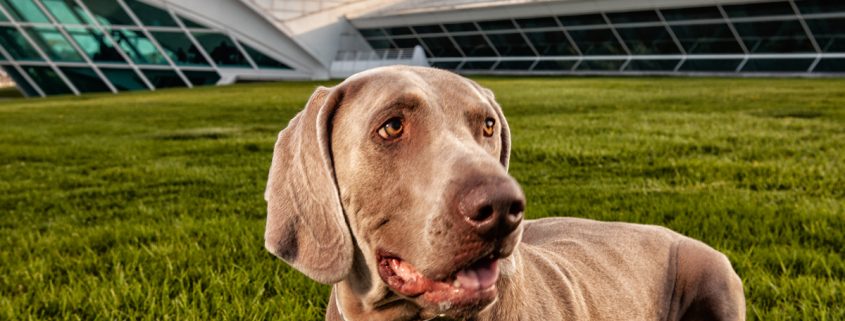
The “Grey Ghost,” “The Dog with the Human Brain,” and “The Shadow Dog” are words that have been used to describe the strikingly handsome and versatile Weimaraner. Because of their almost super-canine physical and mental abilities such as great intelligence, good eyesight, an excellent sense of smell, and extreme agility, Weimaraners need persistent, early training and a structured lifestyle. They are strong-willed and can be stubborn. Fortunately, they do have a cooperative spirit and can be trained to work together with their owners. They are loving and loyal and will never leave your side—unless of course you send them out on an “assignment.”

History

The Weimaraner was developed in early 19th century Weimar, Germany, by Duke Karl August. As a keen sportsman, the duke wanted to create the perfect hunting dog. Therefore, Bloodhounds were crossed with German and French field dogs, and perhaps Greyhounds and Great Danes. The result was a sturdy, athletic and intelligent dog capable of hunting both game birds, and fur-bearing animals such as foxes and hares.

The AKC recognized the Weimaraner in 1943, and some American GIs brought them back home from Germany after WWII. It was not until the 1950s however that the American Weimaraner population really took off. Both President Dwight Eisenhower and Grace Kelly were enthusiastic Weim owners.

“A Tired Weimaraner is a Happy Weimaraner”

Weimaraners need both physical and mental activity to fulfill them. They are not the best dog for apartment living because they really do need room to move and can, in fact, sprint at 35mph. Weims also need their minds to be focused on non-destructive behaviors. Without these two parameters, they will definitely take things into their own paws, finding their own fun. So leave them unsupervised at your own risk! For reasons of safety in the field, Weimaraners are asked to utilize their intelligence and loyalty by both thinking independently and following our human commands. Again, early training is very important.

Life at Home

Weimaraners are Velcro dogs. Not only must they be near us, they need to be touching us constantly to be truly happy. They are prone to separation anxiety, but that can be managed. Weims are also nosy and don’t want to miss out on anything that is going on around them.

Weimaraners are not unfriendly but can be somewhat aloof with strangers. They bark and are good watchdogs. My friend, former Weimaraner owner Marylou Mader, told me, “These are not aggressive dogs, but when it comes to intruders and protecting their family, a Weimaraner will let them in but will not let them out.”

Because Weimaraners were bred to hunt fur-bearing animals, having them around cats might not be a great idea. Weimaraner and cat interactions must be supervised and managed very carefully. They are good were kids, but where very young children are involved discretion is advised.

Health Issues

Weimaraners are general healthy but do suffer from some health issues. Among them are hip dysplasia, bloat and panosteitis. Because they are predisposed to vaccine reactions, a specific vaccine protocol is necessary, with timing being extremely important.

Weimaraner Activities Today

Today, Weimaraners participate in obedience, agility, field work, conformation, search and rescue, and cuddling.

Is a Weimaraner for You?

If you are looking for a little piece of history (or arguably art history) in a loving, sociable, handsome, and energetic dog, the Weimaraner just might be for you. Although Weims are not for inexperienced dog owners, if you do a little homework, know your challenges and prepare to follow through, a Weimaraner could be your kind of Vselcro!

Weimaraners in Art

Since the early 1970s, artist and photographer William Wegman has been photographing his beloved Weimaraners, sometimes in costume, always intriguingly posed and often appearing to be performing everyday human activities. Other celebrities who have owned and loved Weims include Dick Clark and Robin Gibb.

Homeland: Germany

Original Job: Hunting fur-bearing animals & game birds, Pointing & Retrieving

Size: Males 25-27inches, 70-80 lbs. Females 23-25 inches, 55-77 lbs.

Coat Colors: Light silver grey, tan taupe, dark grey

Eye Colors: Blue, “bird of prey” or “lizard” (beer color)

Grooming: Minimal, but they shed a lot

Exercise: Good runs & long walks

Lifespan: 10-13 years

June 13, 2018/by Pamela Stace
https://fetchmag.com/wp-content/uploads/2018/06/weim.jpg 800 1200 Pamela Stace https://fetchmag.com/wp-content/uploads/2021/10/Fetchlogo2022rgb-3-300x175.jpg Pamela Stace2018-06-13 07:57:042023-12-29 12:49:28Weimaraners: My Kind of Velcro
Features For Fido

CELEBRITY PAW PROFILE: Rover: Wagmore Edition

By MANETTE KOHLER, DVM

William Shakespeare once said, “The eyes are a window to your soul.” Photographer Andrew Grant allows us a glimpse into the beautiful eyes and souls of hundreds of dogs, many of which are shelter and rescue dogs awaiting their forever homes, through his stunning photography in “Rover: Wagmore Edition.” This beautiful coffee table book, published by Firefly Books, Ltd., is the sixth edition in a series of Rover books and is a collection of some of his most heartwarming and soulful dog portraits. Now in their ninth year, the Rover project’s (RoverWorks.org) mission is to raise awareness of the millions of pets (dogs and cats) that enter shelters and rescues and to promote the adoption of these deserving animals. “After visiting a few shelters, I quickly learned that their greatest challenge is raising money for spay and neuter programs, health care for the animals they take in, facility operations, overhead and the list goes on,” explains Grant. “Our biggest goal is to raise more money for the best and most effective rescues in the country,” he adds.

This project came from humble beginnings. Andrew is a commercial photographer and was on a shoot in a friend’s large kitchen showroom. “My friend’s two French Bulldogs repeatedly strolled through the set,” shares Grant. “We began to include both dogs in a few of the shots. They sat right where we wanted them and peered straight into the lens,” he adds. He later mentioned that perhaps he should do a book of dogs–someday. “I soon learned that every year, millions of cats and dogs enter shelters in America and are in need of new homes, so ‘someday’ became ‘next week’ and I began photographing dogs for Rover,” says Grant.

During the first nine months, Grant had much serendipity in his life. He conceived the project, photographed all the dogs, edited and designed the entire book, and contracted an overseas printer and saw his book featured on the “Ellen Degeneres Show” as her favorite new book. “Watching everything fall into place so easily assured me that I was on the right path,” says Grant. The first book “Rover” was followed by four more limited edition books and were all self-published.

Early on, Grant launched a program that enabled pet lovers to have their dog photographed and included in the next Rover book when they made a donation of $5,000 to a pet rescue. “That program has now generated donations of over $2 million for over thirty rescues across the country,” shares Grant. “Most of the dogs in “Rover” once lived in a rescue or shelter,” he adds. Both purebreds and mixed breeds are depicted, and Grant wishes to highlight the fact that purebreds account for over 30 percent of the dogs awaiting new homes.

They also feature dogs currently living in rescue or shelter through a “sponsor a homeless animal” donation. “These images are also given to the rescue to share on their website and social media platforms to help increase their changes for adoption,” explains Grant. Photographing these homeless dogs is very rewarding for Grant, seeing them enjoying themselves out of their cage and on the receiving end of a constant flow of treats as Grant tries to capture compelling shots of their true personality, knowing this may help them find their forever homes.

Grant has definitely grown as a photographer since embarking on the Rover project. This project remains his focus today but he still continues to pursue some commercial photography as he travels around the country. The fifth book, “Rover: Haute Dog Edition,” came out in November 2017 and retails for $125. Grant partnered with Firefly to produce a smaller, more affordable version of the book, “Rover: Wagmore Edition,” for $40. “Firefly is able to share our combined message and efforts on a much larger scale,” says Grant. This book is truly stunning and would be a welcome addition to any dog lover’s coffee table.

“When you adopt a cat or dog, you are not just saving the life of one animal but also are clearing the space for so many others to be taken off death row to be adopted,” Grant adds. To find out more and see Andrew Grant’s work, go to RoverWorks.org.

March 22, 2018/by Manette Kohler
https://fetchmag.com/wp-content/uploads/2018/10/Rover-wagmore-edition.jpg 1200 1200 Manette Kohler https://fetchmag.com/wp-content/uploads/2021/10/Fetchlogo2022rgb-3-300x175.jpg Manette Kohler2018-03-22 16:38:592023-12-29 12:49:37CELEBRITY PAW PROFILE: Rover: Wagmore Edition
The Vet Is In

Puppy Proofing 101

By KERRI WIEDMEYER, DVM, WVRC

Getting a new puppy is a very exciting time in anyone’s life!

It can be such a fun time with much to consider and learn: when to vaccinate, how to train them, what to feed them, etc. But before you even bring that bundle of joy into his or her new forever home, you may have to do some puppy proofing.

Environment

It is very important to make the puppy’s environment safe, and it is similar to baby proofing your home. Use baby gates to keep the pup in or out of rooms. Hide electrical cords, and keep them out of reach. Consider crate training your puppy to keep them both safe and as a potty training tool. Puppies should never be left unsupervised with toys or bones as they may choke or swallow them. Puppies may also try to chew or eat non-edible items in the house, such as clothing items, furniture, carpet, etc. Proper training is very important to avoid such problems.

Toxins

Foods. This is not an all inclusive list, but these are some of the more common foods that are either toxic or cause problems in our pets

  • Chocolate and coffee can cause GI upset, arrhythmia, seizures, potential death
  • Grapes/raisins can causes kidney failure
  • Xylitol products (sugar-free gum and other sugar-free products) can cause hypoglycemia, liver failure
  • Macadamia nuts can cause lethargy, lameness, CNS depression
  • High fat foods can cause GI upset and pancreatitis
  • Fruits with pits can cause GI obstruction
  • Chicken/turkey bones can cause possible GI perforation and upset
  • Moldy garbage can cause GI upset, tremors, seizures
  • Onion/garlic can cause anemia

Medications/Drugs. Alcohol, marijuana, over-the-counter human medications and prescription medications should never be given to dogs or cats without consulting a veterinarian. Also, animal medications should never be given to an animal that they are not prescribed for as this could result in unforeseen complications or illness.

Household products. Once again, this is not an all-inclusive list, and these are items that commonly are ingested, as they may taste good.

  • Rat poison. There are several different kinds: Anticoagulants can cause bleeding, Bromethalin can cause severe neurologic problems
  • Cholecalciferol can cause Vitamin D toxicosis
  • Antifreeze can cause kidney failure
  • Household cleaners (effects vary depending on the product)

House plants: All plants should be investigated if your pup is going to be around them. This is just a short list of common plants.

  • Sago Palm can cause GI upset and liver failure
  • Oleander, Foxglove, Lily of the Valley, Milkweed (can be toxic to the heart)
  • Rhododenrons can cause GI, cardiovascular and neurologic signs
  • Araceae family can cause oral irritation, GI upset, rare respiratory disease

As stated above, these lists are the most common items that we see causing problems. If there is any concern about something a new puppy gets into, please contact your veterinarian to be certain. Now that you have a better idea of how to maximize the safety of your new addition to the family, do not forget to have fun and enjoy every minute with your new puppy!

March 22, 2018/by Kerri Wiedmeyer
https://fetchmag.com/wp-content/uploads/2021/10/Fetchlogo2022rgb-3-300x175.jpg 0 0 Kerri Wiedmeyer https://fetchmag.com/wp-content/uploads/2021/10/Fetchlogo2022rgb-3-300x175.jpg Kerri Wiedmeyer2018-03-22 16:31:542020-07-22 21:36:08Puppy Proofing 101
Page 11 of 15«‹910111213›»

Looking for Something?

Search Search

Archives

For Book, Product & Article Review:

Email us for further instructions.

FOR DIRECT QUESTIONS:

Nastassia Putz, Publisher
(262) 337-1967

nputzfetchmag@gmail.com

FOR ADS/DISTRIBUTION:

Current Circulation: 10,000 to 13,000 copies per quarter, distributed to 300+ locations throughout Southeastern Wisconsin (Milwaukee, Madison, Racine/Kenosha, Green Bay).

Questions? Email us at info@fetchmag.com.

© 2025 - FETCH Magazine • franklin web designer
  • Link to Facebook
  • Link to X
  • Link to LinkedIn
  • Privacy Policy
  • Terms of Service
Scroll to top Scroll to top Scroll to top

This site uses cookies. By continuing to browse the site, you are agreeing to the use of our cookies.

Accept and ClosePrivacy PolicyDeny

Cookie and Privacy Settings


How we use cookies

We may request cookies to be set on your device. We use cookies to let us know when you visit our websites, how you interact with us, to enrich your user experience, and to customize your relationship with our website.

Click on the different category headings to find out more. You can also change some of your preferences. Note that blocking some types of cookies may impact your experience on our websites and the services we are able to offer.

Essential Website Cookies

These cookies are strictly necessary to provide you with services available through our website and to use some of its features.

Because these cookies are strictly necessary to deliver the website, refusing them will have impact how our site functions. You always can block or delete cookies by changing your browser settings and force blocking all cookies on this website. But this will always prompt you to accept/refuse cookies when revisiting our site.

We fully respect if you want to refuse cookies but to avoid asking you again and again kindly allow us to store a cookie for that. You are free to opt out any time or opt in for other cookies to get a better experience. If you refuse cookies we will remove all set cookies in our domain.

We provide you with a list of stored cookies on your computer in our domain so you can check what we stored. Due to security reasons we are not able to show or modify cookies from other domains. You can check these in your browser security settings.

Google Analytics Cookies

These cookies collect information that is used either in aggregate form to help us understand how our website is being used or how effective our marketing campaigns are, or to help us customize our website and application for you in order to enhance your experience.

If you do not want that we track your visit to our site you can disable tracking in your browser here:

Other external services

We also use different external services like Google Webfonts, Google Maps, and external Video providers. Since these providers may collect personal data like your IP address we allow you to block them here. Please be aware that this might heavily reduce the functionality and appearance of our site. Changes will take effect once you reload the page.

Google Webfont Settings:

Google Map Settings:

Google reCaptcha Settings:

Vimeo and Youtube video embeds:

Other cookies

The following cookies are also needed - You can choose if you want to allow them:

Accept settingsHide notification only